Thursday, January 24, 2013
Wednesday, October 10, 2012
Tuesday, October 9, 2012
Albrecht square piano
Every now and then then, I come across an instrument bearing the signature of its maker.
I could barely contain my excitement when I uncovered this note, hidden deep inside the case of a square piano made in 1813 by Charles Albrecht, written by Charles Deal, Philadelphia, 1813.
It reads:
The Person who first casts his eye on this may know that this Piano was made in the year 1813 about the time Bonaparte was defeated by the Russians.
Charles Deal
(click on image to enlarge)
I could barely contain my excitement when I uncovered this note, hidden deep inside the case of a square piano made in 1813 by Charles Albrecht, written by Charles Deal, Philadelphia, 1813.
It reads:
The Person who first casts his eye on this may know that this Piano was made in the year 1813 about the time Bonaparte was defeated by the Russians.
Charles Deal
(click on image to enlarge)
Monday, June 18, 2012
Broadwood Square
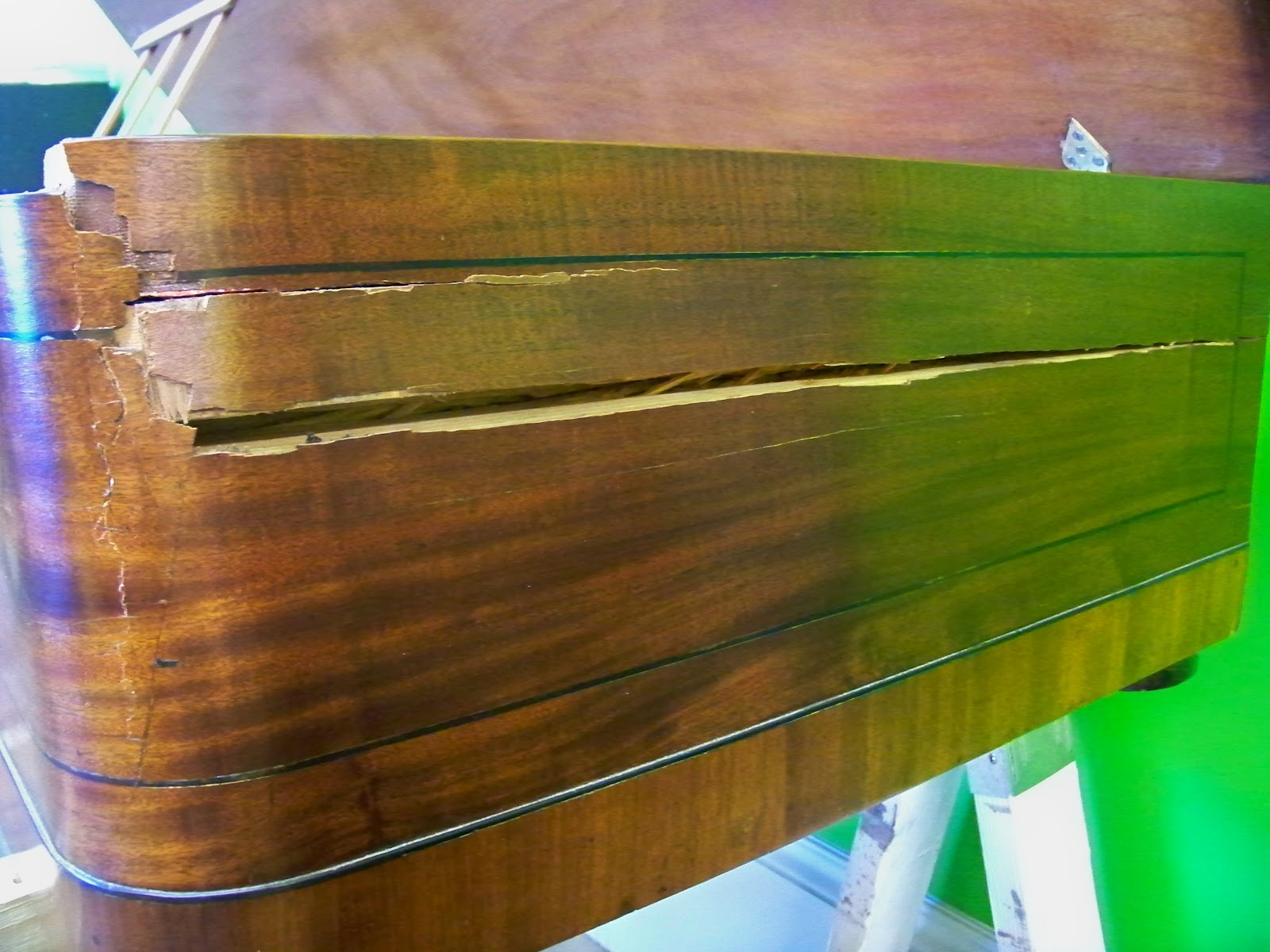
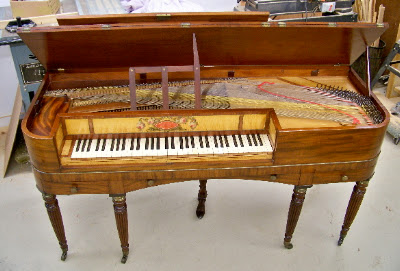
Pictured is a Broadwood square grand, maker's number 36022, built circa 1826.
The instrument was restored a few years ago, and the quality of the work was quite good.
Unfortunately, the right side of the case could no longer withstand the enormous tension of the hitchpin rail, and has failed spectacularly.
Stay tuned.
(Click on images to enlarge.)
Friday, March 23, 2012
Clementi Square Piano
Pictured is a Clementi & Co. square grand, makers number 14537, circa 1818, which will eventually undergo a complete restoration.
Unfortunately, it appears that a well intentioned but rather incompetent "restorer" did some work on the instrument at some point in its life, having replaced the original overspun bichord bass strings with single, overly heavy wound strings, along with a few other inappropriate additions and "improvements."
Fortunately, the instrument is complete. The ivories are all present, and in remarkably good condition, as are the original hammers.
Monday, January 16, 2012
Friday, January 13, 2012
French Double Manual Harpsichord
Pictured is a French double manual built by David Jacques Way, 1988, belonging to the Curtis Institute of Music in Philadelphia, PA.
Unfortunately, this instrument had undergone a previous "restoration" of very poor quality.
Saturday, April 2, 2011
John Broadwood & Son
With a bit of research, I've discovered that the Broadwood grand #3448 is pictured on page 87 of the English version of Ernest Closson's The History of the Piano, after finding a reference to it in an article by Kenneth Mobbs, "Stops and other special effects on the early piano." (Early Music, Volume 12, No. 4, November, 1984; footnote #6, page 476.)
Saturday, March 19, 2011
Friday, March 11, 2011
Thursday, March 10, 2011
Broadwood fortepiano action
The unrestored action, with the signatures of Cochran and Bishop, two of the many craftsmen who worked in the Broadwood factory.
Wednesday, March 9, 2011
John Broadwood & Son Fortepiano, Maker's Number 3448
It was customary for the Broadwood firm to mark the maker's number on the belly rail, wrestplank, stand, and music desk. Pictured below is the maker's number, 3448, inscribed in pencil on the lower belly rail, stamped on the top of the front section of the stand, and in ink on the bass section of the wrest plank. (Click on images to enlarge.)
The desk for this instrument, however, is stamped with the maker's number 1622.
Unfortunately, instrument number 1622, built in 1799, does not appear to have survived.
Tuesday, March 8, 2011
Thursday, March 3, 2011
Broadwood fortepiano restoration
Here is a view of the interior, from the underside, showing the newly repaired and reinstalled soundboard, treble brace, and secondary liner along the spine.
A view of the top, showing the new and original sections of the hitchpin rails, as well as the newly shimmed and shellacked soundboard.
Another view of the top.
A view of the top, showing the new and original sections of the hitchpin rails, as well as the newly shimmed and shellacked soundboard.
Another view of the top.
Broadwood/square nails
Before there were Home Depot, Ace or True Value Hardware stores, builders and craftsmen relied upon their local blacksmith for their supply of hand made nails, such as the ones pictured here.
Friday, February 11, 2011
Broadwood piano soundboard
Here is a view of the underside of the soundboard, with linen cloth applied on the cracks, and of the soundboard re-installation.
Friday, January 7, 2011
Tuesday, December 14, 2010
Broadwood Fortepiano
After a long hiatus, I have begun the restoration of the the 1806 Broadwood grand. Pictured is my beautiful new bride, Sylvia, celebrating the successful removal of the strings, and the interior of the instrument. As happy as I am to have the opportunity to restore this instrument, I feel even more fortunate to have a wife who is equally excited to assist me with its restoration.
Monday, July 5, 2010
Opus IV Keyboard: All has not been lost
With a bit of patience and perseverance, I have successfully restored the keyboard and keyframe, which was badly damaged due to a flooded workshop.
The walnut keytops and cherry arcades have been re-glued to the levers, and with the installation of the walnut cheek-blocks, key cloth and keyframe front molding, it is now ready for installation.
It was necessary for me to adopt a different attitude and mindset in the restoration of this once finished and perfectly functioning keyboard, which I had considered to be the finest I had yet built.
Having done countless restorations of keyboards and keyframes from harpsichords, clavichords, virginals and fortepianos, as well those from modern pianos, this was a project that I simply had to approach as yet another restoration of a damaged keyboard, setting aside the frustration I felt with having to restore a keyboard I had so recently completed.
Tuesday, May 18, 2010
Opus IV: Saving the keyboard
Having allowed the waterlogged keyboard and frame to dry out for a month, it appears that I will be able, after all, to rebuild it.
The walnut keytops have been removed, numbered, and prepped for regluing, and the keylevers appear to have suffered less damage than I had previously thought, save for some staining at the balance points, the result of the balance pins having rusted.
I have polished the guide and balance pins, rebuilt a slightly warped keyframe, and have begun the process of regluing the natural keytops onto the keylevers.
The prospect of building an entirely new keyboard was, to say the least, demoralizing, however, I am quite optimistic that I will be able to resurrect the original keyboard, a tedious, yet far less time consuming task than building a new one from scratch.
The walnut keytops have been removed, numbered, and prepped for regluing, and the keylevers appear to have suffered less damage than I had previously thought, save for some staining at the balance points, the result of the balance pins having rusted.
I have polished the guide and balance pins, rebuilt a slightly warped keyframe, and have begun the process of regluing the natural keytops onto the keylevers.
The prospect of building an entirely new keyboard was, to say the least, demoralizing, however, I am quite optimistic that I will be able to resurrect the original keyboard, a tedious, yet far less time consuming task than building a new one from scratch.
Friday, April 2, 2010
A bit of a setback
I discovered, in the aftermath of a flooded basement/workshop, that the keyboard for my Opus IV harpsichord has been destroyed. Fortunately, the instrument itself, along with my tools and machines, suffered no harm.
The making of the keyboard, an extremely time consuming process, represents the birth of an instrument, as it is the first thing I make for a new instrument.
While it will indeed be a challenge to duplicate the dimensions of this keyboard, I am quite confident that I will be able to accomplish this task, with the hope that the new keyboard will be even better than the original.
Despite this very disappointing setback, my Opus IV will one day sing.
Subscribe to:
Posts (Atom)